Automatic Garage Doors Explained: A Homeowner’s Guide
Why people automate
Most homeowners explore automation for the obvious reason: not getting out of the car in the rain. But the secondary benefits often matter more once the door is in. An electric door locks itself through the motor gearing when it closes. Modern operators use rolling-code radio, so the remote’s signal changes with every press and can’t simply be captured and replayed. And because automation is nearly always specified alongside a modern insulated door, the garage itself usually gets warmer, drier and quieter in the process. Running costs are usually modest, but they are not identical from one installation to another: the annual electricity cost depends on the operator’s standby draw, door size and weight, frequency of use and the household’s tariff. As a broad guide, many modern domestic systems are likely to cost only a few pounds to low tens of pounds per year to run, rather than being a major household energy expense.
Start with the door, not the motor
The type of automatic garage door you choose determines almost everything that follows: cost, headroom requirements, insulation performance and how straightforward the door will be to automate. Options cover a wide spectrum. At the lower end, you may be able to add an £850 retrofit motor to an existing retractable up-and-over door. At the higher end, fully integrated roller or sectional doors with app control typically start from around £3,000, with plenty of mid-range choices in between.
Side hinged doors can be automated too, but the hardware is more specialised and usually costs more. Across all door types, doubling the width generally adds around 55% to 100% to the cost of a single door, putting many double-door installations in the £3,000–£6,000 range.
Useful tip: Specifying an up-and-over door as automatic from the outset is uncommon. It does not usually work out cheaper than an entry-level roller door and is generally considered to offer less inherent security than a purpose-built automated system.
Safety and compliance: What are the core features to look for?
| Feature | What It Means | Why It Matters |
|---|---|---|
| Force limitation | The motor must be set so the door cannot close with enough force to cause injury, automatically limiting the pressure it applies if it meets resistance. | This is a core safety requirement. It prevents crushing injuries and ensures the door reacts safely when it encounters an obstacle. |
| Photocells (infrared safety beam) | An infrared beam across the opening can detect a person, pet or object in the doorway and stop the door before contact. However, photocells are only one part of the safety system. | They add important protection, but the complete door, motor and controls must be assessed and tested together to confirm that the installation meets the required safety standard. |
| Safety edge for roller doors | The tubular motors used in many roller doors do not include built‑in force limitation, so a pressure‑sensitive safety edge along the bottom rail is normally required to stop and reverse the door if it touches an obstruction. Domestic sectional doors often use alternative safety systems, such as force monitoring or photo‑eyes. |
A safety edge ensures roller doors can detect obstacles and react safely. You should ask exactly which safety devices are included and how the finished installation will be tested. |
| Door and motor combination testing | A drive unit that passes on one door may not on another. The specific combination of door, operator and controller must have been tested together. |
Compliance depends on the tested combination, not just individual components. Testing the actual door–motor–control setup confirms that the installed system meets the required safety standard. |
Before choosing an automated garage door system, it’s worth checking that the key safety and compliance features are properly built in and tested. A good installer should help you understand how each device works and confirm that the full setup meets the required standards.

A fully integrated automatic garage door system, where the door, controller, and motor work together as one seamless unit for smoother, safer operation.
The part most buyers never hear about: Safety law
A powered garage door is legally machinery. It must carry a valid UKCA or CE mark and be supplied with a Declaration of Conformity, as required under the Supply of Machinery (Safety) Regulations 2008. BS EN 12453 supports this by defining the safety requirements — including entrapment protection and closing-force limits — that a compliant power-operated door must meet. If your installer cannot provide the paperwork, treat that as a red flag, not a formality.
None of this is “set and forget”. A sensible routine for a domestic door is a quick monthly check: does the door reverse immediately if you interrupt the photocell beam or place a suitable test object in its path? An annual professional service should check force settings, lubricate moving parts and confirm that sensors have not drifted out of calibration. This matters more than it might seem. A door that has “always been fine” can develop a fault gradually, and force limiters that have not been checked for years are a common finding on service calls.
A few practical points specific to family homes:
- Keep remote controls out of reach of young children and consider a keypad or app control instead of a permanently fitted wall button if the garage is a play or access route.
- Never let children treat the door as a toy. Pinch points at panel joints and guide rails can trap fingers. Choose sectional doors with pinch‑resistant panels to reduce the risk of injury.
- If you’re buying an older house with an existing automated door of unknown age, it’s worth a professional safety inspection before relying on it, particularly if there’s no documentation of when it was last serviced.
- During a power cut, doors without battery backup won’t operate automatically. Make sure your installer shows you how to use the manual release cord or lever so you can safely disengage the door from the motor.
Security: The feature too important to skip
The flagship standard to look for is Secured by Design (SBD) – a UK police-backed accreditation scheme under which the complete door assembly (panel, frame, hinges, locking points and automation) is tested against a sustained forced-entry attack in an accredited lab.
In practice, this usually means an automated door benefits from enhanced security features, such as multi-point or motor-driven automatic locking, anti-lift or anti-lever protection, and secure frames, hinges and fixings. Availability varies by door type and operator model. Both Hörmann, when paired with its own ProMatic or SupraMatic automation, and Garador offer SBD-accredited ranges. Other premium manufacturers, such as JDUK may not always carry SBD certification but can still offer high-end specifications, including thick insulated panels and electronic motor locks that help resist forced entry from the bottom of the door.
Buying tip: Insist on a motor that mechanically locks the door when closed and uses rolling-code remotes, which help prevent the signal-cloning attacks that older fixed-code remotes are vulnerable to. Keep the SBD certificate and any product information on file. Some insurers may take accredited security products into account, but only if you can document them.
How to choose the right automatic garage door?
There is no single automatic garage door that is best for every home. The right choice depends on the opening, available headroom, how the garage is used, the level of insulation and security required, and the automation features you actually need.
- If the garage is attached to the house or a bedroom is nearby: Prioritise a well-insulated sectional door with soft-start/soft-stop automation, or tracks fitted with smart-connection systems from models like Hörmann’s LPU 42 or JDUK’s Premier-Line, designed to reduce operating noise. In this situation, reducing vibration and transmitted noise can be more valuable than saving a few hundred pounds.
- If you want app or smart-home control: Choose an operator and door combination such as a Somfy or a sectional door’s own factory-matched operator with clearly supported app functionality. Check the manufacturer’s current compatibility information before buying rather than assuming that every smart-home platform will work with every motor. We will talk you through this to make everything straightforward.
- If headroom or internal space is limited: A roller door can be advantageous because the curtain rolls into a compact housing rather than requiring the horizontal tracking arrangement used by many sectional doors. Check the manufacturer’s minimum headroom and fitting requirements for the exact model. For example, the Hörmann RollMatic OD requires only 60 mm.
- If you have a large or double-width opening: Sectional doors handle wide, heavy openings more gracefully than up-and-over doors because the panel weight is distributed across multiple horizontal sections. They are especially useful for double garages, where an up-and-over panel’s weight and swing can become a practical issue.
- If security is the priority: Look for independently recognised security accreditation where available, and consider features such as automatic mechanical locking, anti-lift protection, secure frames and rolling-code remote controls. Check the accreditation for the exact door and configuration rather than assuming that every model in a manufacturer’s range has the same certification.
Aftercare
Automatic garage doors need relatively little day-to-day maintenance, but safety checks should not be treated as optional.
A sensible homeowner routine is to check that the door operates normally and that its safety system responds as expected. Follow the manufacturer’s instructions for any user-level tests rather than improvising tests that could damage the door or create a hazard. Many manufacturers recommend professional maintenance and servicing every 12 to 18 months.
This is important because a professional eye can spot issues the untrained eye cannot. For example, a door that has gone out of balance can force the motor to work harder and can push impact forces outside the safe range, even when nothing looks obviously wrong.
Professional servicing should check the door’s balance, moving components, track or guide system, operator settings and safety devices. If the door becomes unusually noisy, moves unevenly, fails to reverse as expected, or develops another change in behaviour, stop relying on it until it has been inspected.
If you have bought a property with an older automated door and cannot establish its service history or safety documentation, arrange a professional inspection before treating the system as safe for routine use.
Before you place the order
Even if you’re just doing your own personal check before ordering, it helps to know that we, as your installer, make sure every detail is covered so nothing gets overlooked.
| Item to Confirm | What to Ask | Why It Matters |
|---|---|---|
| Written quotation | Request a full quote covering the complete installed system, not just the door price. | Ensures transparency and avoids unexpected costs. |
| Daily use and practicality | Confirm how the chosen door supports your day‑to‑day use of the garage. | Ensures the door suits your lifestyle and access needs. |
| Door model and dimensions | Check the exact model, size and configuration being supplied. | Prevents sizing errors and ensures the correct product is ordered. |
| Colour and finish | Confirm the precise colour, texture and finish. | Guarantees the door matches your home and expectations. |
| Materials and sustainability | Ask what materials are used and how eco‑friendly the door is. | Important if environmental impact or durability matters to you. |
| Thermal performance | Confirm insulation levels and thermal ratings if relevant. | Helps maintain comfort and energy efficiency in attached garages. |
| Operator/motor compatibility | Check the exact motor model and its compatibility with the door. | Ensures reliable operation and compliance with safety standards. |
| Safety devices | Confirm all included safety systems such as force limitation, photocells or safety edges. | Guarantees the installation meets required safety regulations. |
| Controls and access options | Check remote controls, keypads, wall switches and any app‑based functionality. | Ensures you have the access methods you prefer from day one. |
| Battery backup | Confirm whether a backup battery is included or recommended. | Keeps the door usable during power cuts. |
| Extra building work | Ask if any structural adjustments or preparation work are required. | Avoids delays and additional costs during installation. |
| Removal of old door | Confirm removal and disposal of the existing door is included. | Saves you arranging separate disposal and keeps the project tidy. |
| Warranty arrangements | Check product warranties and what they cover. | Provides long‑term protection against defects. |
| Recommended servicing intervals | Ask how often the door and motor should be serviced. | Keeps the system safe, reliable and compliant over time. |
| Documentation | Confirm you will receive conformity certificates and product documentation. | Provides proof of compliance and essential reference information. |
| Workmanship guarantee | Ensure the installation is covered by a quality workmanship guarantee. | Protects you if any installation issues arise later. |
This makes competing quotations easier to compare and helps prevent a low initial price from becoming more expensive if additional controls, safety equipment or installation work are added. The cheapest automatic door is not necessarily the best-value option, and the most expensive specification is not automatically the best choice. The strongest installation is the one that is properly matched to the opening, correctly automated, appropriately protected and supported by clear documentation and aftercare.
Expert note
This guide has been prepared with input from garage door specialists experienced in specifying, installing and maintaining automated domestic garage doors in the UK. It reflects practical knowledge of common door types, automation systems, safety requirements, security considerations and aftercare issues encountered during real installations. The article also references recognised UK safety and security frameworks, including the Supply of Machinery (Safety) Regulations, BS EN 12453 and Secured by Design, to help homeowners make informed decisions based on compliance, safety and long-term performance rather than price alone.
Reviewed by: Karl Humphris, Garage Door Specialist, Easten Garage Doors, with 40 years’ experience in domestic garage door installation, safety compliance and automated access systems in the UK.
Automatic Garage Doors Explained: A Homeowner’s Guide
If you’re trying to get a clear sense of what a sectional garage door is, this page gives you a straightforward explanation in plain, everyday language.
Sizing.
A full range of standard widths (2.08m up to 5.5m) are available.
We offer supersize options spanning from 5.5 m up to 8 m wide.

Large insulated sectional garage door, shown here in a supersized format suitable for openings beyond 5.5 m.
Operating modes.
We supply sectional garage doors with smooth, balanced manual operation, using a low‑effort, ergonomic handle that makes everyday opening feel light and controlled.
Upgrading to electric automation with a ceiling‑mounted motor to power the door movement will enhance convenience.
Safety Compliance (UK).
Automated systems must comply with BS EN 12453 for force limitation and obstacle detection required for safe manual operation. Furthermore, they must carry the UKCA marking.
Top Tip: Look for workmanship guarantees
Choose an installer who offers a clear workmanship guarantee – a five‑year term is a strong signal of a reputable, quality‑focused provider. Notably, when paired with the manufacturer’s servicing guidelines, it helps support long‑term safety and compliance.
Panel construction.
Not only do foam‑filled steel panels form the main body of the door, but they also have internal protective layers designed to maximise long‑term durability.

Illustration depicting the Carteck Automatic standard for layered protection
Rollers and tracks.
Sectional garage doors use matched rollers and tracks that are engineered to stay securely in place, giving it a stable, dependable structure. The components are designed to work quietly together. Tandem rollers can add an extra level of smoothness and control, whilst tension‑sprung tracks include built‑in features that help the door stay aligned and secure.
Spring system.
Sectional garage doors use a spring system positioned either above the opening or integrated into the tracks, depending on the installation requirements. These balance the door and contribute to its safety and reliability as a complete unit.
Panel joint design.
Sectional garage doors use interlocking panels that create a tight connection between each other when closed, supporting overall strength. In addition, this type of door construction has no gaps, improving draft‑proofing.

Interlocking panels showing how each section connects tightly to eliminate gaps and improve draft‑proofing, illustrating the construction of a modern sectional garage door.
Boom connected to an operator.
Sectional garage doors are automated using a rigid boom arm engineered to work with the manufacturer’s own operator system. The boom connects directly to the top panel, delivering smooth, consistent and reliable opening performance.

Anatomy of a sectional garage door.
A complete sectional system includes:
- Multi-panel door leaf
- Centre and end hinges
- Nylon or steel rollers
- Vertical, curved, and horizontal tracks
- Spring and balancing system
- Bottom seal and frame seals
- Automation unit with boom
- Manual or system-based locking mechanisms
Each component plays a specific role in stability, movement, and long‑term performance.

A high‑clarity 3D visual showing all components of a sectional garage door, created to support explanations of “what a sectional garage door is” and how the system functions.
Types of openings a sectional door can fit.
A sectional garage door is versatile when it comes to ‘what openings it can fit’. Because it opens vertically and doesn’t swing out, it works with almost every common garage shape – even ones that other types of door struggle with.
Here’s a clear breakdown.
- Standard rectangular openings
- Arched openings (Full or Partial Arch)
- Non‑standard or irregular openings
- Wide double garage openings
- Tall openings
- Low headroom openings

Sectional garage doors are designed to suit most opening shapes thanks to their flexible multi‑panel construction. This installation shows how the system adapts easily to a triple‑aspect, barn‑style structure.
The features described do not always apply to the standard versions and can vary according to model and type of door.
What is a Sectional Garage Door?
Sectional garage doors operate by lifting a series of hinged horizontal sections. Basically, as the door moves each panel travels along a curved track before sliding back along the garage ceiling. Consequently, there is no outward swing, so driveway space is maximised. The panels are connected with articulated hinges, guided by smooth-running rollers, and supported by calibrated springs. When automated, a motor drives the movement, enabling the door to open and close effortlessly. Altogether, components work as a well-balanced system to ensure that weight, motion and safety are controlled effectively.
Video: How a Sectional Garage Door Works.
This video shows how a sectional garage door moves as its individual panels lift and travel along the overhead tracks.
What controls a sectional garage door when it closes?
Spring system regulates the weight.
Torsion or extension springs counterbalance the door’s mass, allowing the panels to descend in a measured, stable motion instead of falling under gravity.
Tracks and rollers guide the panels.
Precision‑engineered rollers travel inside the track system, keeping each section aligned and preventing lateral movement as the door lowers.
Hinges and couplings control panel articulation.
Hinges between the panels pivot at the correct moment, allowing the door to fold and straighten smoothly throughout the downward travel.

This hinge connects two sectional garage door panels and allows them to pivot as the door transitions, a key part of how a sectional garage door works.
Operator (motor) manages speed and force.
When automated, the operator uses a controlled drive system to regulate:
- Closing speed
- Stopping force
- Soft‑start and soft‑stop behaviour
This prevents slamming and reduces mechanical strain.
Safety sensors prevent accidents.
Photo‑eye sensors and force‑monitoring systems ensure the door closes only when the path is clear, supporting a consistent, predictable motion – reversing the door if an object is in the way.
What controls a sectional garage door when it opens?
When the door rises, the system activates a coordinated lifting mechanism that elevates the panels and transitions them from vertical to horizontal. During the opening cycle, these components take charge:
Spring system balances the door.
Springs counterweight the door, enabling the panels to rise without abrupt movement or excessive load on the mechanism.
Tracks and rollers direct the upward travel.
Rollers within the track system maintain alignment and ensure each panel moves upward in a stable, controlled path. Likewise, tension-sprung tracks with built in safety features help to prevent derailment.
Tandem rollers made from durable steel and high‑grade nylon, often with sealed bearings, reduce wear and extend service life – especially on heavier doors.
Hinges and couplings manage panel flexing.
Hinges pivot at precise intervals, allowing the door to articulate cleanly as it transitions from the vertical plane into the overhead position.
Operator (motor) controls lifting dynamics.
When automated, the operator regulates:
- Lifting speed
- Acceleration and deceleration
This produces a smooth, predictable opening cycle.
Torsion or Tension Springs?
Sectional garage doors rely on a counterbalance system to make lifting safe and manageable.
- Torsion springs sit above the opening and store torque as they wind and unwind.
- Tension springs sit inside the tracks and stretch or contract under load.
Nevertheless, both systems reduce the effort required to lift the door, ease strain on the operator, and keep movement steady and predictable. The choice of spring is dependent on structural requirements of the garage, the weight of the door, and the headroom available – as defined by our professional surveyors.
Operator Systems.
Modern sectional doors pair with advanced operator units. Motors may use belt, chain, or direct‑drive systems housed inside a centrally mounted boom fixed to the ceiling. The operator connects to the top panel and works in harmony with the spring system, track design, and security features to deliver consistent operation, uniform pulling forces, and automatic locking. This ensures lifting and closing forces transfer smoothly throughout the door’s travel path.

The operator powers the sectional garage door by driving the trolley along the rail, pulling the door open and pushing it closed—an essential component in how a sectional garage door works.
In summary.
The result of each component working in harmony is a finely balanced door that ensures ribbing and section transitions are evenly distributed at every position. This makes sectional garage doors one of the most versatile and high‑performing options for residential properties. The coordinated mechanisms deliver smooth lifting, secure closing, strong insulation, and long‑term reliability. For homeowners comparing garage door types – or researching upgrades – understanding how these parts interact is essential for choosing high quality doors that have refined and well-developed details.
The features described do not always apply to the standard versions and can vary according to model and type of door.
How Do Sectional Garage Doors Work?
What front door colour would best complement a home? It’s an important question. As a home’s first port of call it’s the first impression – and sets the tone for the inside – combined with door furniture, styling, and glazing to create a pleasing entry way. When design is well thought out; of high quality, and is architecturally sympathetic, it can have a favourable impression. Here are some tips!
Give personality to a front door?
Choose a front door that complements a home’s architectural style and surroundings. Use existing elements – brick, stone, cladding, window frames, or garage door colours – as a guide. Soft heritage shades suit period homes, while also contrasting well with contemporary or traditional red-brick exteriors. Prefer a luxurious entrance? Black creates a particularly opulent looking entryway. You can also take your lead from the landscaping – natural tones blend with greenery, while neutrals also highlight vibrant gardens. Despite the prominence of matching garage and front doors, it isn’t always essential to pair like for like; instead, aim for harmony with the home’s palette. Whether bold or subtle, the right colour can unify and elevate your exterior. Then there is the hardware. Whether brass, steel, silver, or aluminium, doorknobs, handles, and knockers bring distinctive character and charm to a front door.
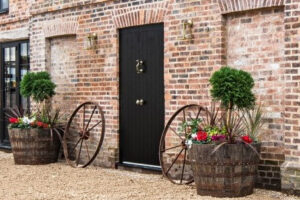
Go traditional!
Composite and uPVC doors are the perfect blend of versatility and minimal maintenance, making them a sought-after choice for homeowners and designers alike – with 100s of colour options and a dazzling array of glass designs. Go for the elegance of a timeless classic, the charm of an artistic arch combination, or the sophisticated allure of highly decorative etched patterns – they are transformative.
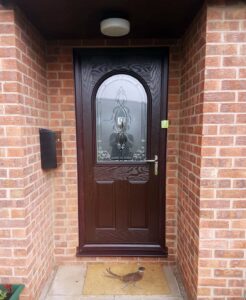
Natural wood.
Front doors can become striking focal points when made with timber. Their rich grain, texture, and colour variations bring character and charm to any home—whether traditional or modern. For a warmer, organic feel, natural wood or wood-effect finishes pair beautifully with nearby timber structures, creating a cohesive and inviting entryway that feels both contemporary and connected to its surroundings.
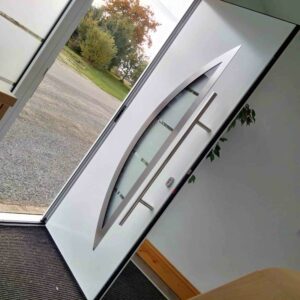
Make it modern!
Looking for a modern aesthetic? These are often minimalist in style with smooth surface finishes that reflect a sleek look. Combine them with minimal furnishings; sometimes this can simply be a slick T-Bar Pull Handle with a matching stainless steel house number.
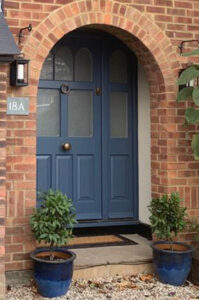
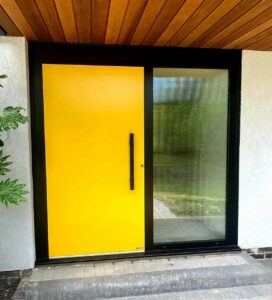
Add a pop of colour!
Go bold with a pop of colour that jumps out against the surrounding materials and structures. They work well when contrasting brickwork or cladding.
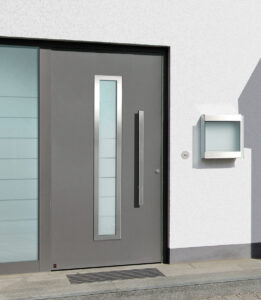
Add an Elegant Twist.
Light or pastel tones that blend seamlessly into a home’s exterior can imbue a sense of calm and serenity. The effect can be refined and elegant. For example, a warm grey tone that ties in with a property’s stonework; cream that follows through to a painted render; or a dusty blue against bluey- grey slate tiled walls.
Be neighbourly.
Neighbouring entrances can double the impact when colour choices are coordinated. They don’t have to match, simply complement one another. Blend in? Or stand out? Either way is fine. Contrasting shades can go together. Navy Blue & Warm Taupe, Black & Classic White, or Dusty Rose & Soft Olive. Matching is also OK. Either way, a good tip is to mirror the styling elements, such as hardware, panel design, or finish, to create balance.
Front Doors shape first impressions of a home – whether bold contrasts, complementary colours, or a harmonious match, they’re a reflection of personal style. From classic timber and modern glass to sleek metal finishes, there are countless ways to make your front door a standout feature. Remember, it’s not just an entrance—it’s the gateway to a home, setting the tone for what lies beyond. So, choose wisely and let your front door make a statement!
7 Brilliant Colour Tips for Front Doors

One of the best ways to keep your home secure is through the use of high quality garage door security. Securing your garage door involves several factors: from choosing the right kind of door to installing motion sensors and alarms. Therefore, here are five ways you can upgrade your security in order to keep thieves from gaining access.
Choose a Secure Garage Door
The first factor you should consider when improving your garage door security is the garage door itself. Is it made from a material that is strong and resilient, like steel or insulated aluminium? You should also check the quality of your locks. If feasible, a remote-controlled locking system may give you a higher level of security than before. By securing your garage door you are removing one of the most obvious points of entry for any would-be thieves.
Add Motion Sensor Lighting
To further increase your garage door security you should consider setting up motion sensor lights outside your home. Once the motion sensor detects movement the system will flood the area with light. This should deter potential thieves by removing their cover of darkness. Infrared sensors are the most common form of motion detector, but there are others such as photoelectric and microwave. Explore your options and choose the one that best suits your home.
Install An Alarm
Should motion sensor lighting fail to deter thieves, then having an effective alarm system in place is the next step in garage door security. Your alarm system should cover every entry point in the home, including the garage door. The most viable alarm systems are those that allow you to monitor your property and send alerts to your mobile devices should an incident arise.
Use Garage Shield
To further strengthen your garage door security installing a garage shield is highly recommended. Many thieves can enter through your garage door by simply wedging the top panel open and using a tool such as a coat hanger to pull the emergency release cord within. A garage shield is a small device made from recycled plastic that encloses the garage’s opening mechanism, preventing thieves from reaching the release cord.
Secure Your Front Door
While focusing on garage door security is important, do not forget to check the security of your front door as well. Just as with the garage door, check the strength and resilience of your front door as well as how effective the locking mechanism is. You may be able to upgrade both front and garage doors at the same time, with designs that complement each other in both looks and overall security.
How Eastern Garage Doors Can Help
At Eastern Garage Doors we offer a wide selection of secure and bespoke garage doors to clients throughout the local area. Whether you are looking for a new garage door that will upgrade the security of your home or a selection of external front doors we can provide exactly what you need for your home. To find out more or ask for a free no-obligation quote contact us online or via phone today.
5 Tips to Keep Your Garage Door Secure and Thieves Out
While wooden garage doors undeniably add timeless charm to a home, over time, exposure to the elements – such as rain, snow, extreme temperatures, and UV rays – can cause deterioration. Spring is the perfect time to give them some much-needed maintenance after months of exposure to harsh weather. With proper care, of surfaces and moving parts, they can remain looking great for years to come. Our handy guide explains what you’ll need to do to keep your door functioning and looking good.
Repaint Your Wooden Garage Doors
Harsh weather conditions can cause paint or protective coatings to chip, peel, or fade, leaving the wood vulnerable to moisture damage and decay. Inspect the door for signs of warping, water damage, or peeling paint. If you notice any issues, remove the old paint, sand the surface smooth, and apply a fresh coat. For the best protection, use an exterior-grade acrylic or oil-based paint designed for wood, as these provide durability against the elements. Wood stain, sealer, varnish, natural oils or even cladding can also be considered to refresh or enhance the grain.
Observe Your Door in Motion
Take some time to observe your wooden garage doors opening and closing. Do they open smoothly or is there a jerkiness to their motion? Are they quiet or do you hear scraping noises as they move? If your doors are not opening smoothly and quietly then check the system, including springs, cables and pulleys, to make sure that they are all clean and symmetrical.
Clean and Clear the Tracks
In order to easily open your garage door, the tracks need to be clean and free of any blockages such as debris. Use a level to determine if the tracks are perfectly even. Any bends or damage can put stress on your doors.
Check For Loose Hardware
There are many moving parts that make up the opening mechanism for your wooden garage doors. Over time these parts can loosen, which poses a risk to how well your doors operate. Using screwdrivers and an adjustable wrench, make sure to tighten any loose screws and bolts holding your brackets and fasteners in place.
Inspect the Rollers
Over time your garage door rollers will become chipped or loose, making your doors harder to open. Replace any damaged rollers you find by removing them from the brackets and inserting a new one. Keep in mind that you should not remove the bottom rollers as these are attached to the garage lift cables. If you need to replace these, always call a professional.
Check Pulleys and Cables
Your lift cables and pulleys help lift the wooden garage doors, and if these become damaged the doors will be harder to open. Inspect the cables attached to the bottom roller brackets as well as any cables or springs in the pulley system overhead. If any loose parts or fraying is detected, only fix it yourself if you are an expert.
Clean and Lubricate Moving Parts
Use a lubricant spray such as lithium grease on rollers, brackets and tracks and other moving parts that are stiff and hard to move. This will help reduce stress and improve their lifespan.
Test Garage Door Balance
If your wooden garage doors are off-balance then they will force your opener to work harder, leading to possible early failure. To test the balance, disconnect the door from the opener via the safety cord and manually lift it to halfway. If you let go and the door remains in place then it is well balanced. If it slides up or down you will need to turn to an experienced specialist to rebalance it.
Test Auto Reverse Features
All modern garage doors have a safety feature that stops them from closing when an object is detected. Test the pressure sensor by placing an object such as a board under the door as it closes. The door should reverse when it touches. Afterwards, test the door’s photoelectric sensors by waving a broom handle in front of them. If this movement does not trigger a reversal, check there is nothing blocking the cameras. If the problem persists, bring in a pro.
Check the Weatherstripping
Weatherstripping is necessary for keeping your garage doors insulated throughout the year. Check the bottom and sides of the doors to see if the stripping is clean and in good condition. If it has become worn down, replace it by removing any nails to disconnect the old weatherstripping and put in a new one. You can purchase weatherstripping from any hardware store.
Eastern Garage Doors
At Eastern Garage Doors we have a range of products and services that will provide you with the perfect garage door for your home. To find out more about our bespoke wooden garage doors contact our friendly team.
A Guide to Garage Door Maintenance in The Spring
It is common for many places to have a garage that houses cars, tools or otherwise acts as a storage area. But your garage can be used for much more than just storing away unused items. You could convert your garage into an office space for working from home. Or use the space to create a garage gym for working out at home. There are many different options for garage space utilisation to consider if you want to make the most of your space. Therefore, here are some lockdown garage conversion ideas to turn your garage into an office, gym, garden room or anything you like.

Turning Your Garage Into An Office
The first thing to consider when turning your garage into an office is how suitable it is as a living space. If your garage is bare concrete then the right flooring, walls and insulation should be checked out as well as windows for ventilation. Consider the style and aesthetics you want for your office and furnish it accordingly with suitable furniture and décor. Remember to supplement natural light from the windows with adequate artificial light. Consider investing in an insulated garage door to make sure you save on heating costs, protect the content and also have the opportunity to convert back into a garage if and when the time is right.
Making A Garage Gym At Home
Having a garage gym will allow you to work out at home at any time without costly gym memberships. Once you have cleaned out your garage space you can start the process by putting in flooring such as gym cushions. Next, bring in the workout equipment you need: dumbbells, benches, rowing machines and so on. Make sure the gym and entrance provide both good ventilation, privacy and security access. Side hinged or sectional garage doors are some recommended varieties. Finally, bring in any entertainment equipment such as TV or music players to complete your home gym experience.
Other Garage Space Utilisation Ideas
Here are some other lockdown garage conversion ideas for your home:
- Turn it into a well-lit and spacious study area.
- Create a calm and well-stocked working studio for creative projects.
- Make a playroom for children with plenty of space for toys.
- Turn it into an entertainment and media room with TV and sofa setup.
- Convert it into an annex for any visitors or guests.
- Create an extra living room for other members of your family.
- Transform it into a spacious modern kitchen area.
- Create a utility room or laundry area.
- Create a garden room for your plants, or perhaps combine it into a garden bar area.
Using Eastern Garage Doors For Lockdown Garage Conversions
At Eastern Garage Doors we provide top quality service on alterations and conversions of garages and doors so you can make the most use of your space. We also provide insulation, flooring and furniture supplies to create the space you need. To find out more visit our garage conversion page. At Eastern Garage Doors we provide a wide range of services for garages, carports, front entrance doors and more. To speak with our friendly and professional team contact us online for a free online survey and no obligation quote today.
Ideas For Converting Your Garage Into an Office or Gym
Unfortunately, Christmas is a time of increased break-ins as thieves go looking for presents to steal. Although most people take the correct precautions to protect their front and back doors, garages are sometimes overlooked and present an easy way in. We’ve put together some of the steps you can take to keep your garage – and by extension, your home – safe and secure over Christmas.
Keep the remote hidden
If you have an electric door, keep the remote in a safe place. These doors are becoming more and more common in the UK, and it’s tempting to keep the remote in your car for convenience. However, this makes it easier for thieves steal it and gain access to your garage. It’s best to get into the habit of bringing your garage door opener into the house with you, then keeping it somewhere safe inside. If you absolutely have to leave it in your car, keep it in the glove box so it’s harder for thieves to access.
Cover up any windows
If there are windows that look into your garage, cover them up to avoid any potential thieves from getting a look at what’s stored inside. Garages with uncovered windows are more likely to be broken in to, and the risk is even greater if you have tools and other valuables kept in there.
Keep it shut
This might sound like the most obvious advice, but it’s pretty normal for people to leave their garage door open for long periods of time while they’re at home. Although you might be okay leaving it open and going back and forth from the garden while working on a DIY project, you never know who could be taking notice of the expensive tools and equipment that you keep in the garage. Keeping the door shut if you’re going to be round in the garden for a while is your best bet for extra security.
Keep the entry door locked
If your garage is attached to your house, the door between the two should be just as secure as your front and back doors. If any intruders do somehow make their way into your garage, you want to stop them from getting any further into your home with a securely locked door.
Use a secure door from Eastern Garage Doors
One of the most important factors in keeping your garage safe is a sturdy, secure garage door. You can find plenty of different doors in our range that includes options such as sectional, roller, remote-controlled and many more.
Every single one of these doors is secure as standard, but they can be tailored to your needs for further security, for example with the addition of automation.
Why not improve your home security as part of your garage winter maintenance? Get in touch with us today for a free garage door quote.
Simple Ways to Keep Your Garage Safe and Sound This Christmas
When you arrive at home or look out into your garden, your garage is probably one of the first things you see. So it’s important that it looks smart and catches the eye for the right reasons. Perfect for period or traditional homes, wooden garage doors can also bring classic style to a modern property.
At Eastern Garage Doors, we supply and install a wide range of wooden garage doors, but what are the benefits of choosing a timber design?

Built to last
Wood is naturally hardwearing, making it an ideal material for a garage door. With the correct finish and a little care, wooden doors can last for many years. Plus the natural grain of wood hides minor scuffs and scratches well. If re-sanded and refinished every three to five years, your wooden garage door will look as good as new.
Customisable
Our wooden garage doors can be finished in any colour. Match your garage to your front door and window frames, or make it stand out with a contrasting shade. The choice is yours. And because a wooden garage door can be repainted, you can easily update its colour as and when you like.
Suitable for automation
An automated garage door can make a big difference to your home. They are particularly useful if you find yourself struggling to safely lift a heavy garage door. Or if you park your vehicle inside your garage.
We can adapt our wooden garage doors for motorised operation, making access safer and more convenient. So even the heaviest timber door can be opened with ease.
Security & insulation
The strength of wood gives you added peace of mind that your garage and its contents are secure. Wooden garage doors also benefit from better insulation thanks to the thickness of the timber. This will protect the contents of your garage from the elements. And your garage will be warmer too – perfect if it has been converted into a home office, gym or play room.
Get in touch to find out more about the wooden garage doors we can install, or to arrange your free, no obligation survey.
A Guide to Wooden Garage Doors
How do you know when it’s a good time to purchase a new garage door? Not only are garage doors meant to protect your vehicle and other valuables from the elements, but they represent a very real asset in terms of security. While most doors are built to last, the fact of the matter is that garage door servicing will be required from time to time. So, how can you tell if a garage door repair will be sufficient as opposed to when an entirely new unit is the most logical option. Let us take a quick look at a handful of variables to address so that you can make the right decision.
When Garage Door Repairs are Sufficient
Minor issues can normally be addressed through a targeted DIY garage door repair. Some of these include:
- Issues with caulking
- Chipping or peeling paint
- Small patches of rotting wood
- Machinery that needs to be oiled
All of these situations can be tackled within a relatively short period of time and little to no prior experience is required. However, there are other times when a simple face-lift is hardly sufficient.
Signs that a Garage Door Needs to be Replaced
What might signal that you require a professional garage door repair? One of the most common issues involves wood that has rotted through all of the panels. As this cannot normally be treated with superficial techniques, a garage door replacement may be the best option.
Another situation to keep an eye out for involves profound mechanical problems. For example, the motors designed to lift and close the door can burn out or otherwise become too weak to supply the appropriate level of power. It is often much more economical to purchase a new garage door as opposed to replacing the entire motor as well as the armature.
You might also be looking to increase the levels of security associated with your existing garage door. In this case, it is often wise to upgrade to a sturdier model. The same holds true if you garage becomes extremely cold during the winter months. Insulated variants will provide you with a host of thermal benefits and as a result, you are likely to save a significant amount of money in terms of heating costs.
To Repair or Replace…That is the Question
We should finally note that obtaining a garage door repair from a professional represents an excellent return on investment. Not only will this newer model last for years at a time, but it can also increase the value of your property. Let’s also not fail to mention that you may also be able to upcycle garage doors; ideal when re-purposing their materials to create objects such as tables and outdoor chairs.
It can still be rather tricky to know whether or not a replacement is warranted. This is why customers choose to speak with an expert at Eastern Garage Doors. We will be pleased to give you an honest evaluation and to point you in the right direction.